The MIT finding that explains the incentive
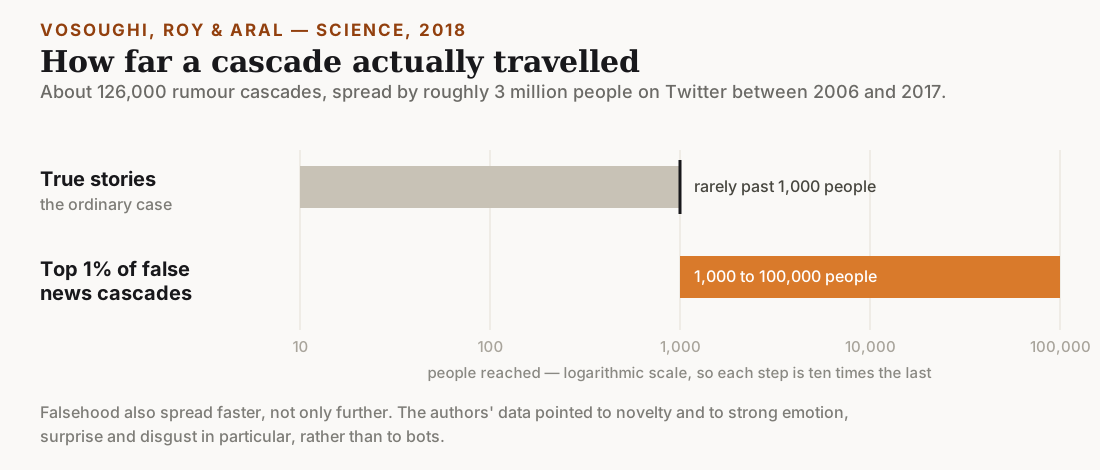
Vosoughi, Roy, and Aral's 2018 study in Science analyzed roughly 126,000 rumor cascades spread by about three million people on Twitter between 2006 and 2017. The top 1% of false-news cascades reached between 1,000 and 100,000 people. True stories rarely reached more than 1,000. Falsehood also spread faster, not just further.
The study's own conclusion is direct: "Falsehood diffused significantly farther, faster, deeper, and more broadly than the truth in all categories of information, and the effects were more pronounced for false political news than for false news about terrorism, natural disasters, science, urban legends, or financial information." Political content, in other words, was the single most outrage-prone category in the entire dataset.
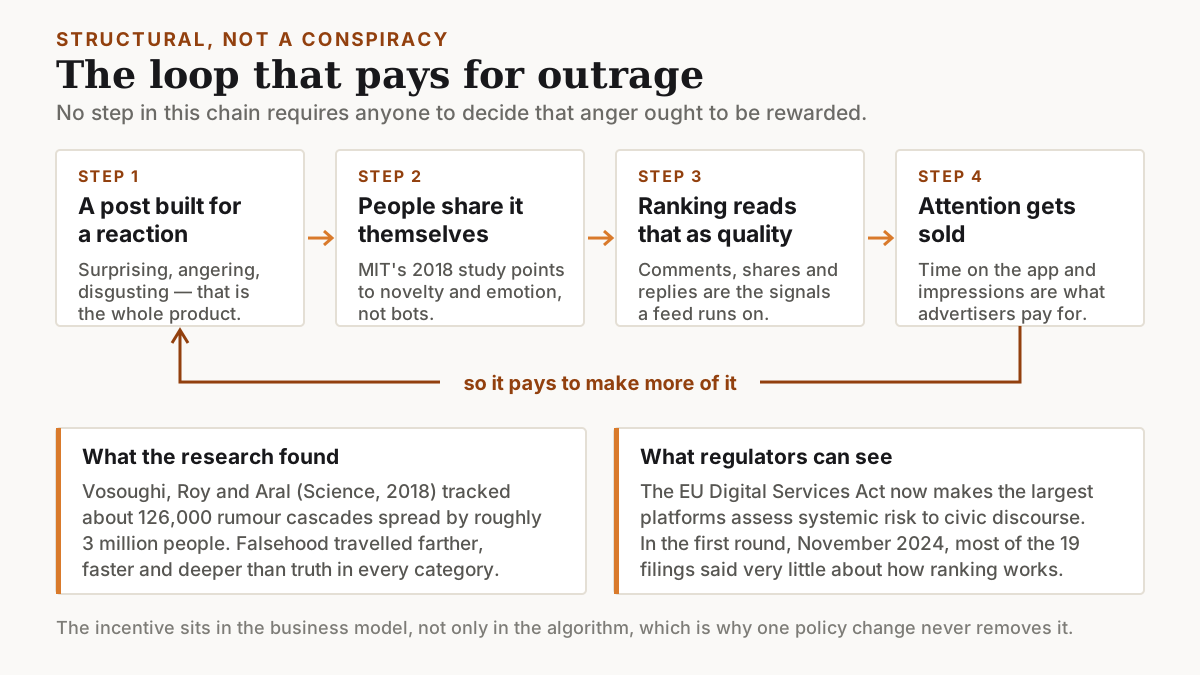
The researchers' explanation was not bots. Their data pointed to novelty and emotional reaction, especially surprise and disgust, as the stronger predictors of sharing. People were more likely to retweet content that felt new and made them feel something strongly, and false claims are, structurally, easier to make surprising than true ones.
Novelty and emotion, not a conspiracy
This matters for how to think about rage bait, because it is tempting to imagine platforms secretly boosting anger on purpose. The MIT study suggests something less conspiratorial and more structural: ordinary human sharing behavior already favors novel, emotionally charged content, with or without algorithmic help. Rage bait works by supplying exactly that.
What platforms have actually admitted
Platforms have, at times, acknowledged the problem directly. Facebook's 2017 crackdown on "engagement bait", covered in the Anatomy of a Rage Bait Post explainer, is a company on record saying certain engagement-optimized patterns were distorting its own ranking system enough to justify a policy change.
Attention is the business model
Most major platforms sell advertising priced on attention: time on the app, impressions, and engagement. Content that reliably produces a reaction, whether that reaction is a comment, a share, or a reply, performs well by the metrics that determine what gets shown to more people, independent of whether the platform's engineers set out to reward outrage specifically. The incentive exists at the level of the business model, not just the algorithm.
Regulators have started requiring platforms to check their own homework
The EU's Digital Services Act (DSA) is the most concrete attempt so far to legislate against this incentive directly rather than leave it to individual platform policies. Article 34 requires the largest platforms and search engines (classified as Very Large Online Platforms, or VLOPs) to conduct annual assessments of "systemic risks" their algorithmic systems create, explicitly including harm to civic discourse and electoral processes. Two separate transparency articles back that up: Article 14 requires platforms to spell out their content-moderation policies, including algorithmic decision-making, in their terms and conditions, and Article 27 separately requires any platform that uses a recommender system to explain, in plain language, the main parameters that system actually uses to decide what gets shown to whom.
The first round of these mandated assessments came due in November 2024, covering 19 VLOPs and VLOSEs. According to an analysis by Liberties.eu, a European civil liberties coalition that reviewed the filings, most platforms disclosed only minimal detail about how their recommender systems actually prioritize content, and the analysis names algorithmic amplification's effect on civic discourse as a "major blind spot" the first-round filings left unaddressed. A second round of reports followed in November 2025, and a March 2026 follow-up analysis by Liberties.eu and the European Partnership for Democracy found "no meaningful evolution" between the two rounds: platforms were still describing systemic risks as something caused by outside bad actors rather than their own design, and recommender-system claims remained largely unverifiable to outside observers. AlgorithmWatch, an independent research organization that tracks the law's implementation, notes that the DSA's own definition of "systemic risk" remains deliberately broad, which is exactly what gives outside groups like Liberties.eu room to keep pressing platforms on what their filings leave out. That gap matters here specifically: amplification's effect on civic discourse is the exact mechanism rage bait exploits, and it's the one regulators themselves say they still can't see clearly, two full reporting cycles in.
What would actually change the incentive
There is no simple fix here. Ranking systems that stopped correlating reach with reaction would likely reduce measured engagement, which is the same metric platforms report to advertisers and investors. That tension, between rewarding what people actually respond to and rewarding what is actually good, is why individual policy tweaks like the 2017 engagement-bait rules, and even a legal mandate like the DSA's risk-assessment requirement, address specific tactics or demand more disclosure without directly changing the underlying math of what a ranking system is built to optimize for.
A note on how this was researched
This piece draws on one peer-reviewed study (Vosoughi, Roy, and Aral, published in Science, a leading peer-reviewed journal), platforms' own published policy statements, and independent legal analysis of a specific, named piece of EU legislation and its first enforcement cycle. It does not draw conclusions about any single platform's current internal ranking logic, which none of these platforms publish in enough detail to verify independently, a limitation the DSA analysis above itself points out. For the construction side of this problem, how an individual rage bait post is actually built, see The Anatomy of a Rage Bait Post; for the media-literacy skills that help regardless of how the underlying incentive gets resolved, see What Is Media Literacy?